Inkling-2-Mini Benchmark Results
Independent measurements of Thinking Machines' Inkling-2-Mini (26.2B total / 3.4B active MoE, looped layers, 1M context) across DGX Spark (GB10), RTX Spark 128GB (N1X), RTX PRO 6000 Blackwell (96GB), and RTX 5090 (32GB). Median of 3 runs per point.
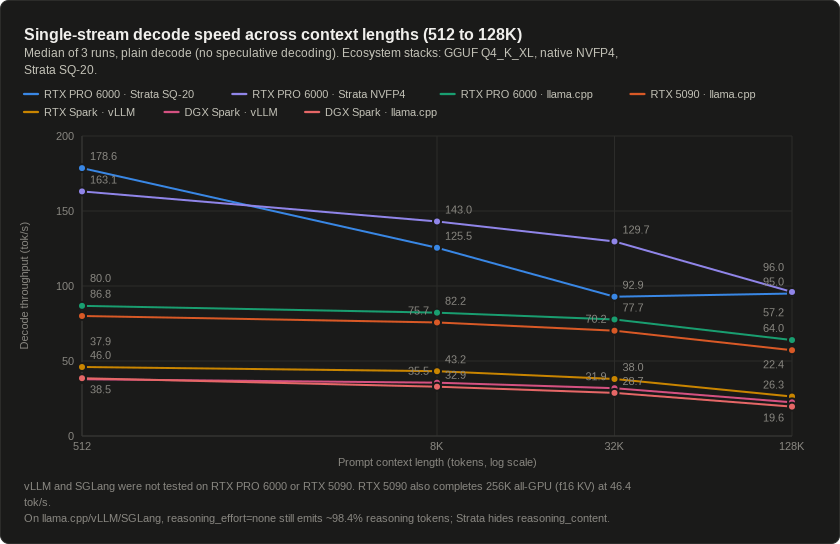
Single-stream decode table
Thinking off, plain decode (no speculation). Select a prompt context length to compare all engines.
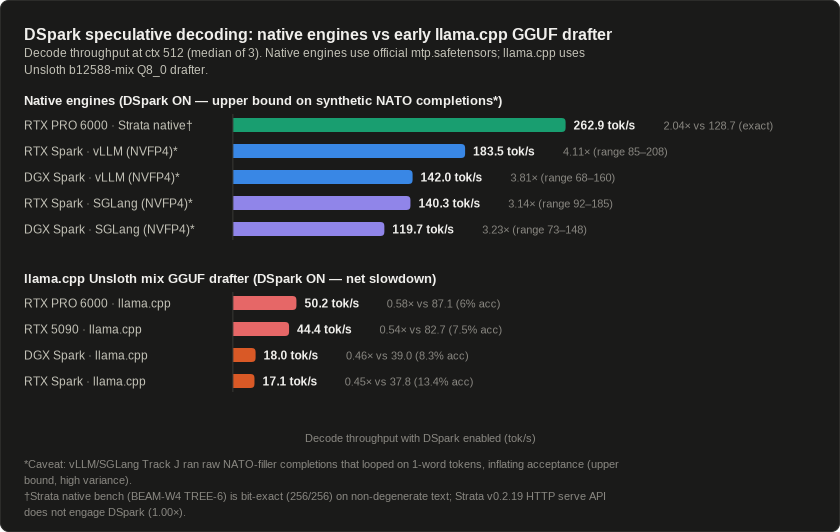
DSpark off vs on (ctx 512 and 32K)
Draft acceptance sits at 6–13% on llama.cpp GGUF (net slowdown) vs 34–88% on native vLLM and SGLang.
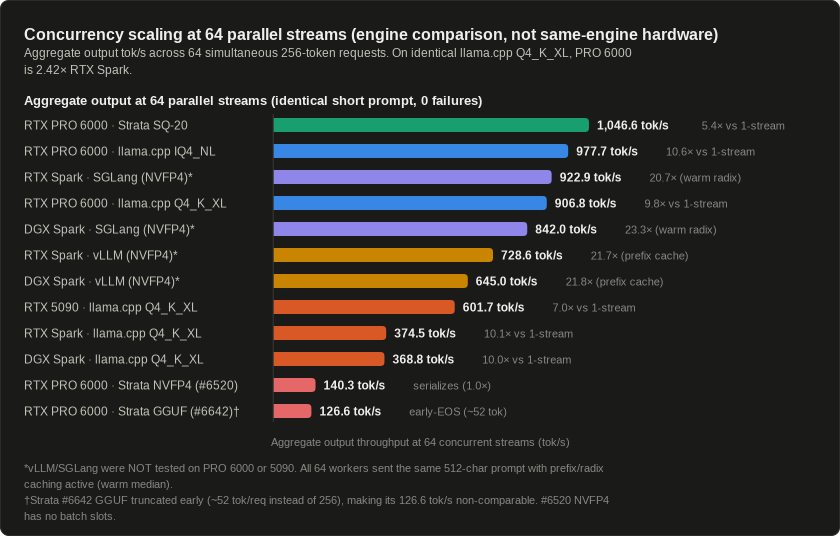
Aggregate output throughput (1 to 64 workers)
On-box local HTTP threads, zero failed workers at every concurrency level.
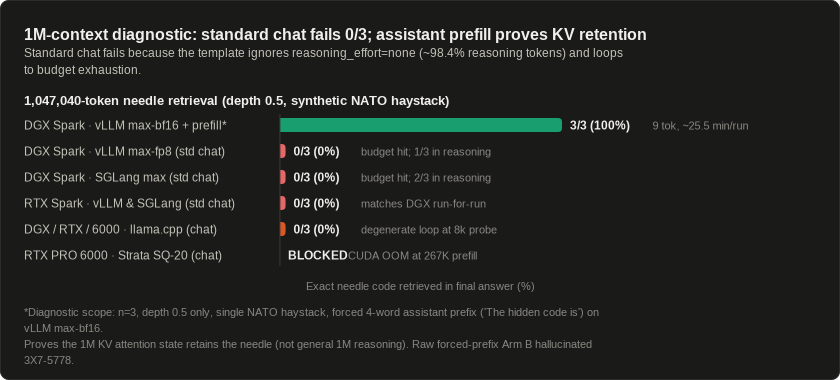
reasoning_effort=none (~98.4% reasoning tokens). At 1,047,040 tokens, standard chat loops until finish_reason=length. Using assistant prefill (continue_final_message) bypasses the loop and retrieves 3/3 exact codes in 9 output tokens on DGX Spark vLLM max-bf16.
Needle-in-a-haystack ladder (16K to 1M)
Exact code hits in final answer content (out of 9 at 16K/65K across 3 depths, out of 3 at 128K/262K/1M).
Capability evals (20 math + 10 sandboxed code) & vision (8 items)
Code is 10/10 across every arm. Vision misses are a deterministic shape-counting limitation (8 shapes → 7/6).
30-minute continuous soak & power efficiency
Three consecutive 10-minute back-to-back request windows.
Adversarial audit & known limitations
Every number in this dashboard matches the raw JSON records on disk. Below are the exact methodological caveats and potential gotchas surfaced by our own raw-JSON and harness-code audit.
| Area | What to know before citing |
|---|---|
| No vLLM / SGLang on PRO 6000 or 5090 | RTX Spark SGLang (922.9 tok/s @64) vs RTX PRO 6000 llama.cpp Q4_K_XL (906.8) is an engine comparison, not a hardware comparison. On identical llama.cpp Q4_K_XL, PRO 6000 is 2.42× faster (906.8 vs 374.5), and IQ4_NL hits 977.7 tok/s. |
| Track E prefix / radix caching | All 64 concurrent workers sent the exact same 512-char prompt across 3 runs without a cache-busting nonce; neither --disable-radix-cache nor --no-enable-prefix-caching was set. Run 0 was 11–23% slower on llama.cpp, so the median is a warm-cached run. |
| Track J DSpark repetition loops | On vLLM and SGLang, Track J's raw NATO-filler completions looped on 1-token words ("mike mike..."), inflating acceptance and creating huge variance (68–208 tok/s). Treat 3.1×–4.1× as a synthetic upper bound. Strata's native bench (2.04×, 256/256 exact) is the cleaner non-degenerate reference; llama.cpp used an early Unsloth b12588-mix GGUF drafter. |
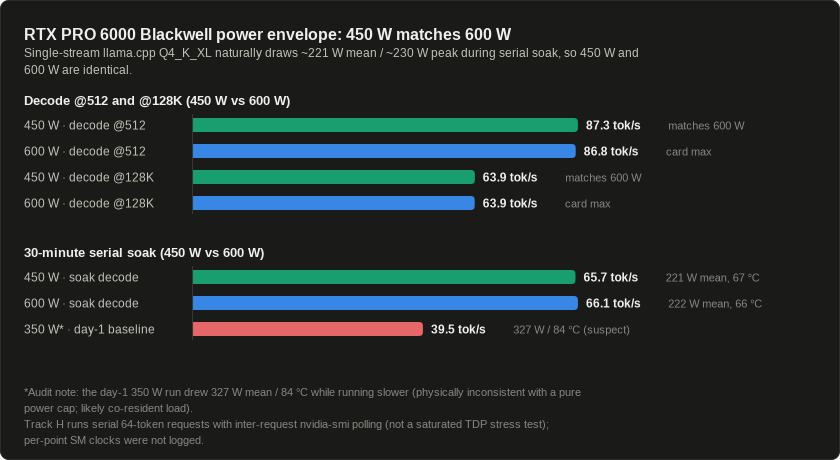
| RTX PRO 6000 day-1 350 W anomaly | 450 W and 600 W (both run cleanly on day 2) are identical within 0.6% (~221 W mean / 66–67 °C). The day-1 350 W run drew 327 W / 84 °C while running slower with a 116% mid-test jump on A@128K—pointing to likely co-resident GPU load rather than a pure power-cap effect. Per-point SM clocks were not logged. |
| Track H serial soak & polling | soak.py runs serial 64-token requests with synchronous nvidia-smi polling between requests, and effective decode_tok_s includes prefill + SSH/Python overhead (explaining RTX Spark's 21.6 over Tailscale SSH vs 39.8 in local WSL2). |
| 1M assistant-prefill scope | Tested on 1 host (DGX Spark), 1 engine (vLLM max-bf16), depth 0.5 only, synthetic NATO haystack, forced 4-word assistant prefix, n=3, ~25.5 min/run. Proves 1M KV attention retains the needle—not general 1M reasoning. Raw forced-prefix Arm B hallucinated 3X7-5778. |
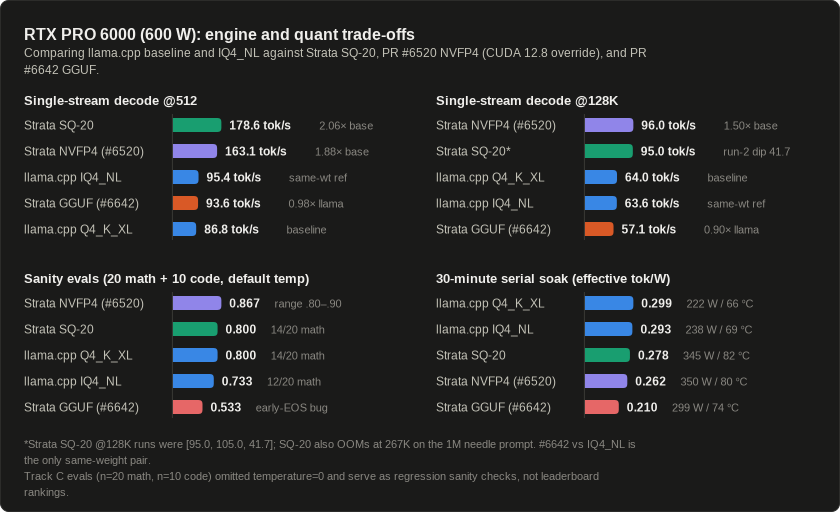
| Small evals & default temperature | Track C (n=20 math, n=10 code) omitted temperature=0.0, causing ±1–3 item math sampling drift across runs. Track G Vision (8 synthetic 128×128 squares, all expected "8", substring check) is a multimodal wiring smoke check only. |
| Strata GGUF & WSL2 caveats | Strata #6642 GGUF early-EOS'd in Track E (~52 tok/req instead of 256) and math (0.30). Strata SQ-20 OOMed at 267K on the 1M prompt and had one 41.7 tok/s outlier at 128K. RTX Spark H2H ran in WSL2 (no power/temp sensor; SGLang mem-fraction-static 0.95 vs DGX 0.75). |